Idle Distiller Tycoon
- 4.4
- Rating
- 1.00M
- Installs
- Free
- Price

 Analysis by App-foxy
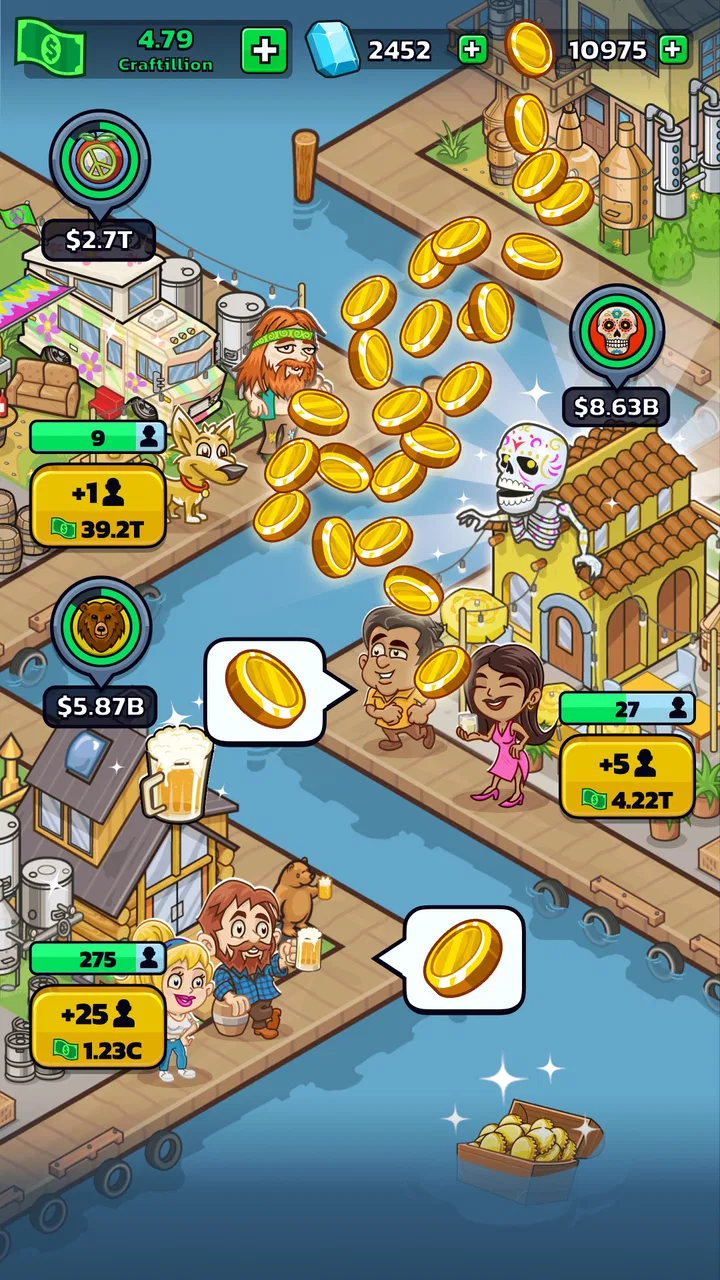
I went into Idle Distiller Tycoon expecting a familiar idle game with a distillery theme, and that is broadly what I found: a light simulation game where I build up a spirits business, check production, collect progress, and decide where the next improvement should go. The setting gives the usual idle formula a more distinctive personality than a generic cash factory, but the appeal still depends on whether you enjoy watching small upgrades gradually turn into a larger operation.
What makes the game easy to understand is its simple first step. I begin by managing the distillery rather than learning a complicated control scheme. The early minutes are about seeing how production works, collecting the result, and putting that return back into the business. That immediate action-feedback cycle matters because it tells me what the game wants me to do without burying the useful information under menus.
Kano Games presents this as a simulation title, although I would describe it more precisely as an idle tycoon game with a distilling theme. It is free to start, carries a Teen content rating, and has reached over a million installs. Its average rating is 4.4 from roughly fourteen thousand ratings, which fits my impression: this is an accessible, focused game that many players will understand quickly, even if its long-term depth will not suit everyone.
You May Also Like

 Blood Strike: 2.5 Anniversary
Blood Strike’s Loadouts Turn Every Drop Into a Tactical Gamble
A close look at Blood Strike’s custom loadouts: how fast access to signature weapons reshapes its battle royale rhythm, rewards preparation, and narrows the gap between fights.

 Pandora - Music & Podcasts
Pandora’s Music Is Easy to Start, but Harder to Recover
Pandora’s strength is its low-effort path from a seed to a station. Its weak spot is how much confidence it asks you to place in connection, setup, and quiet recovery.

 8 Ball Pool
 Is Built on Rivalries, Rematches, and Routine
A close look at the rivalries, rematches, shared routines, and unanswered safety questions that turn a quick pool match into a persistent mobile community.

 Samsung Music
’s Quiet Strength Is Playing What You Already Own
Its reach comes less from spectacle than from dependable access to a personal library. That simplicity is both the app’s strongest retention engine and its ceiling.

 AccuWeather: Weather Radar
AccuWeather Review: A Quick, Clear Forecast for Everyday Decisions
For everyday plans, the best forecast is the one you can understand quickly. AccuWeather makes rain timing, radar, and local conditions easy to act on, with a few trade-offs.

 Hill Climb Racing
Why Hill Climb Racing Still Turns Crashes Into One More Run
A tiny car, a bumpy hill and one more upgrade: Hill Climb Racing keeps resurfacing because its simple chaos makes every near-miss feel personal.
More From Our News Desk



How the distillery loop feels in everyday play
I find the distillery loop easiest to enjoy when I treat each visit as a quick business check rather than a demand to stay online. Before spending a reward, I pause to decide what is actually slowing progress, which turns a familiar collect-and-upgrade routine into a small, useful choice. That habit also makes it clearer whether the game’s steady pace suits me or whether I would rather move on to a more hands-on management game.
The first action is deliberately uncomplicated
The strongest part of the opening is that I can make progress almost immediately. I do not need to memorize a large production chain before I understand the purpose of the next tap. The distillery produces, I collect the outcome, and I use the return to improve the operation. That sequence gives each early interaction a clear reason instead of making me click through decoration.
For a new player, this clarity is useful. The game does not ask me to behave like an actual distiller with technical knowledge about fermentation, barrels, or alcohol production. Instead, it turns the theme into a readable business progression. I am managing a growing enterprise, not studying a realistic manufacturing process. That choice keeps the game approachable, but it also means players looking for detailed production simulation should adjust their expectations.
I found the first upgrades most satisfying when I treated them as ways to remove a bottleneck rather than automatically choosing the most visible improvement. If production is moving slowly, increasing output makes sense. If the operation is earning well but feels inefficient to check, an improvement that supports more passive progress is more useful. This is a small distinction, but it prevents the early game from becoming a routine of tapping whichever button happens to glow.
The distillery theme also gives the opening a clearer identity than many idle games. A restaurant, mine, or city builder can use almost the same framework, while this one frames the progression around spirits and a business that grows from a modest operation into something more ambitious. I would not call the simulation realistic, but the theme is consistent enough to make the numbers feel connected to a place rather than floating in an abstract menu.
Feedback arrives in a steady rhythm
After the first action, the game’s main pleasure comes from feedback. I can see that the operation is doing something, return to collect the result, and then turn that result into another improvement. The rhythm is intentionally gentle. It is not built around constant reflexes, and I never felt that I needed to react instantly to keep the business alive.
That makes it a good fit for short visits. I can open it during a break, make a few decisions, and leave without feeling that I have missed the entire game. It also works as a low-pressure evening game when I want something more interactive than watching a screen but less demanding than a strategy title that requires uninterrupted attention.
A realistic use case is a commute or lunch break. I might open the game, collect what the distillery has made, spend the return on the upgrade that improves the current weak point, and close it again. The session has a beginning, a decision, and a visible result. I do not need a long uninterrupted block of time to feel that I accomplished something.
The trade-off is that the feedback can become predictable. Once I understand the basic relationship between production and upgrades, the surprise comes less from discovering new rules and more from reaching the next milestone. That is normal for an idle title, but it is worth saying plainly: the game rewards patience and repeated check-ins more than constant experimentation.
Rewards work best when I spend them with a plan
The reward is not only the amount collected. It is the feeling that the next visit will be more productive because I made a sensible choice this time. That is where the tycoon element becomes more interesting than simple accumulation. I am not merely watching a number rise; I am deciding how much of the return should go toward faster progress, stronger earning potential, or a smoother routine.
My most useful habit was to avoid spending every reward immediately. Holding back briefly can make sense when I am close to a meaningful improvement, because a small purchase now may delay the upgrade that changes the pace of the whole operation. On the other hand, saving too aggressively makes the current session feel stagnant. The practical balance is to spend when the improvement clearly changes the next cycle, not just because the game offers a button.
This is one of the game’s quieter strengths: it gives casual players an obvious path while leaving room for modest optimization. I can play casually and still progress, but I can also ask why one upgrade is better for my current situation than another. That question adds enough decision-making to keep the theme from feeling completely automatic.
There is also a psychological reward in returning to a business that has continued moving while I was away. The idle structure makes the distillery feel persistent, even though my active role is limited. I check the result, reinvest, and set up the next period of growth. The reason to begin another session is not a new story scene or a demanding challenge; it is the promise that the next collection will support a more noticeable improvement.
Resetting the session creates the reason to return
Every visit eventually reaches a natural stopping point. I collect the available progress, make the best upgrade I can afford, and leave the game to continue its cycle. That reset is important. Without it, the experience would be a single long stream of numbers. By closing the app and returning later, I turn the idle waiting period into part of the structure.
I like this arrangement when I want a game that respects interruptions. A session can end because I have used the available reward, not because I failed a level or ran out of lives. The next opening then feels like checking a business rather than restarting a task from zero. For players who prefer a clear finish to every session, that can be comfortable.
However, the same reset can feel empty if I need a strong sense of completion. There is no guarantee that the next visit will offer a dramatic new experience; often, it offers another round of collection and investment. The loop works because the player accepts gradual growth as the content. If I want missions with varied objectives, tightly designed stages, or a decisive ending, a conventional management game may be a better choice.
I also recommend deciding in advance how often to check in. Opening the game repeatedly without enough time for meaningful progress can make the loop feel like maintenance. A less frequent routine gives the idle element more purpose: I return when there is enough accumulated value to make a worthwhile decision. That simple change made my sessions feel less repetitive.
Where the free model affects the experience
The game is free to download and play, but it includes optional purchases priced from $1.99 to $99.99 per item. That range is important for anyone who dislikes monetization in idle games. The core appeal is built around waiting, collecting, and upgrading, so the temptation to accelerate progress is naturally part of the design.
I would approach the purchase options as convenience rather than a requirement. If I am enjoying the gradual pace, spending is unnecessary to understand the loop. If I am impatient, the presence of paid acceleration can make the normal rhythm feel slower by comparison, even when the free progression is functioning as intended. This is a common tension in the genre, and it is the main point where the game may frustrate players who want every improvement immediately.
My advice is to play long enough to decide whether the basic timing suits you before considering a purchase. An upgrade cannot fix a loop that you fundamentally find repetitive. Conversely, if you like checking the distillery and watching the business grow, the free version gives you a fair way to test that appeal without committing money at the start.
What makes this different from other idle simulations
Compared with a typical idle clicker, this game benefits from having a specific business fantasy. The distillery gives the progression a recognizable setting, and the idea of building an empire provides a clearer destination than simply increasing an anonymous currency. Compared with a deeper tycoon simulator, though, it is lighter. I am not managing every operational detail, balancing a large workforce, or solving complex logistics.
That middle ground is its real position. It is more themed than a bare number-increase game, but more relaxed than a management simulation that expects careful planning at every step. I would choose it over a traditional tycoon game when I want low-pressure progress and short sessions. I would choose the traditional alternative when I want detailed systems, more failure states, or decisions that remain demanding after the first few hours.
It also differs from competitive idle games because the satisfaction is mainly personal. The important comparison is between the distillery I had before an upgrade and the one I have afterward. That makes the game approachable for players who do not want rankings or direct pressure, although it may feel too quiet for anyone who needs social competition to stay interested.
Small habits that improve the experience
First, I would identify the slowest part of the current cycle before spending. The most expensive-looking improvement is not automatically the most useful. If the operation is already producing quickly but the return is not keeping pace, improving the part that limits earnings can make the next collection feel stronger.
Second, I would group play into deliberate check-ins instead of opening the game every few minutes. The idle design is at its best when enough time passes for the return to matter. This also reduces the feeling that I am performing repetitive housekeeping rather than running a growing business.
Third, I would treat each upgrade as an experiment. Notice what changed in the next cycle, then use that observation to guide the following purchase. This approach gives the simple system more depth without pretending that it is a complex economic simulator. It also helps reveal whether I personally enjoy optimization or only enjoy the initial novelty of the theme.
Finally, I would avoid judging the game by the first few collections alone. The opening teaches the loop, but the real question is whether gradual improvement remains satisfying once the basic controls are familiar. If the answer is no, no amount of checking will turn it into a different genre. Recognizing that early is better than forcing myself through a progression style I do not enjoy.
Who should play it, and who should skip it
I think this is a good match for someone who wants a calm business game that can be played in brief visits. It is especially suitable if you like watching a modest operation grow, making occasional upgrade decisions, and returning later to collect the result. The Teen rating also gives a general indication that it is not aimed at very young children, so parents should consider that context when deciding whether it fits their household.
I would recommend skipping it if you need constant novelty, precise control, or a detailed simulation of real distilling. The theme is a frame for idle progression, not a technical course in spirits production. I would also look elsewhere if paid acceleration makes free-to-play games uncomfortable, because the available purchase range is a visible part of the experience even when I choose not to use it.
Device compatibility is fairly broad: the current version is 3.43.6 and it supports Android 7.0 or later. That makes it accessible to people using older supported Android devices, although the quality of any individual experience can still depend on the phone and its overall condition. I would also keep the game updated when possible, since staying on the current version is the sensible way to avoid judging an older build.
My verdict on the complete loop
The action is clear: manage the distillery and collect its output. The feedback is steady: each cycle shows whether the operation is improving. The reward is practical: I reinvest returns into a more productive business. The reset is gentle: I leave, let the idle process continue, and return when another meaningful decision is available. That sequence explains why another session begins without needing a complicated story or demanding challenge.
For me, the loop succeeds when I play it as a small routine rather than a main game. A few thoughtful decisions feel pleasant, especially when I focus on the current bottleneck instead of buying upgrades automatically. The experience loses some of its appeal when I expect every visit to bring a major change, because the design is intentionally built around accumulation.
My honest recommendation is to try it if you enjoy patient, low-pressure tycoon progression and like the idea of running a virtual distillery. The free entry makes that test straightforward, while the optional purchases mean I would keep a clear eye on how much acceleration I actually want. Kano Games has made a focused simulation that understands its audience: it is not trying to replace a full management game, but it gives idle players a themed reason to return.
After spending time with it, I see the game as best used between other activities rather than as an all-day challenge. Open it, make one or two informed choices, let the business work, and come back when the next reward has a purpose. If that rhythm sounds satisfying, Idle Distiller Tycoon has enough personality to make the familiar idle formula worthwhile. If you need complex strategy or constant surprises, the distillery will probably feel too automated before long.
FAQs for Idle Distiller Tycoon
01What is Idle Distiller Tycoon and how does the gameplay work?
Idle Distiller Tycoon is a casual management game where you build and expand your own alcohol distillery. You begin with a small production setup, then unlock equipment, improve manufacturing speed, hire or upgrade workers, and sell products to earn money. Much of the progress continues while you are away, making it suitable for players who enjoy incremental gameplay rather than constant action.
02Can I play Idle Distiller Tycoon without an internet connection?
The game may allow some basic progress while offline, but certain features can depend on an internet connection. Offline earnings are usually collected when you return to the game, while advertisements, cloud saving, special events, leaderboards, and in-app purchases may require online access. Availability can vary by version and device, so it is worth checking the game’s current requirements before downloading.
03Is Idle Distiller Tycoon free to download and does it contain advertisements?
Idle Distiller Tycoon is generally available as a free download, but the free-to-play model may include optional purchases and advertisements. Ads can sometimes be used to multiply offline rewards, speed up production, or receive other bonuses. Purchases are not necessarily required to progress, although they may reduce waiting times. Players who prefer uninterrupted gameplay should review the store listing and in-game purchase options.
04Does the game involve real alcohol, gambling, or age-restricted content?
Although Idle Distiller Tycoon uses distilling and alcohol production as its business theme, it is presented as a fictional management and simulation experience. The gameplay focuses on upgrading factories, collecting virtual currency, and expanding production rather than consuming alcohol or gambling. However, the theme may not be appropriate for every child, so parents should review the age rating, advertising content, and device controls before allowing younger users to play.
05What devices are compatible with Idle Distiller Tycoon, and is progress saved?
Compatibility depends on the specific Android or iOS version available through the official app store, as well as your device’s operating system and available storage. The game is designed for mobile play, but older phones may experience slower performance. Progress may be stored locally or synchronized through an account or cloud service, depending on the version. Before changing devices or reinstalling, confirm that your progress is backed up.
Pros
- Simple idle mechanics make it easy to play in short sessions.
- Production continues while you are away from the game.
- Multiple upgrades provide clear short-term progression goals.
- Bright visuals and relaxed gameplay suit casual players.
- No complex controls are needed
- making it accessible to beginners.
Cons
- Progress can become repetitive after the initial upgrades are unlocked.
- Later improvements may require long waits or frequent resource collection.
- The game may encourage watching ads to speed up production.
- Limited strategic depth can reduce its appeal for experienced players.
- Battery use may increase during longer play sessions.

Idle Distiller Tycoon
Gallery